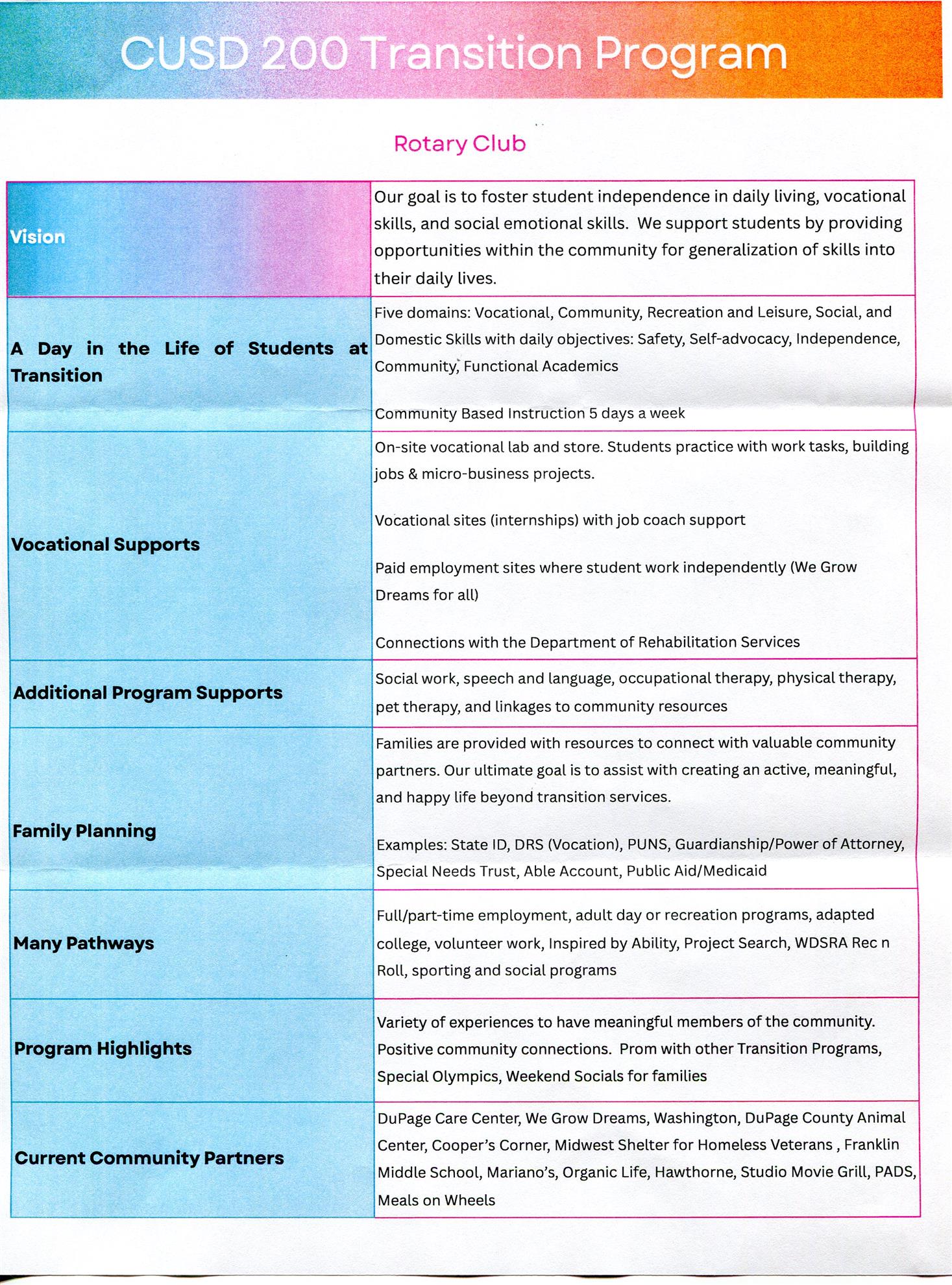
Why: Future planning for any child or young adult can be a difficult process. The process of future planning for a child or young adult with a special need can be overwhelming and tough to navigate. A parent is their child's best advocate and in order to advocate for your child you must be informed. The sooner a parent becomes informed of what types of services and supports their child can benefit from the sooner they can plan for the future. Planning early can alleviate feelings of being overwhelmed during major school transitions and when applying for certain funding or benefits. The reason to get things set in place as early as possible is that it takes a collaborative effort from all the supports listed in the diagram to create a busy, productive and meaningful schedule for a child when they are exiting from the public school system.
How: On the District's website (https://sites.google.com/a/cusd200.org/transition/overview) one can search for federal and state funding/benefits, eligibility for support, reasons for a special needs trust, guardianship or legal alternatives information, transportation programs and contact information to local agencies.
When:
As your child transitions from youth, to young adult and then into adulthood critical steps should to be taken throughout your child's life to ensure eligibility and to help keep doors open for your child and family. Funding for services and programs may depend on the supports you have secured. It is highly recommended to make these connections to outside agencies and linkages as soon as your child is eligible. If you have questions on these services or agencies, please ask questions and request assistance. The following section of the Transition Planning Timeline have suggestions and resources broken down by ages of items to consider when planning a successful future. The timeline is a grid to help the structure of each family's plan.
Elementary School Age
Introduce concepts of work into everyday activities.
Students should become familiar with all types of careers.
Develop self-care and daily living skills and routines.
Focus on human relationships and social skills within the home and school.
Explore vocational opportunities at the upper grade levels that are available.
Ensure accessibility issues or adaptive equipment needs are addressed.
Request information on the Individuals with Disabilities Education Act (IDEA)
Middle School Age
Begin career exploration, watch movies, read books and go to work with adults.
Support the teacher's efforts to provide job training as part of school programming.
Find out the types of educational programming options such as inclusion, vocational, combination, etc.
At home, parents can also help their children explore careers by performing chores around the house and volunteering in the community.
Encourage participation in social skill groups and outside of school extracurricular activities.
Explore self-advocacy information and community advocacy organizations.
Age 14
Learn about PUNS (Prioritization of urgency of Need for Services) and if you need to initiate the process to get on this state waiting list for services. Learn how adult services are obtained, funded and coordinated. Update this annually. See Gov. Funding and Benefits.
Familiarize yourself with public funding realities in Illinois and make plans for the possibility that your family may need to privately pay for any adult services and supports.
Consider the need for a "Special Need Trust" and the impact of accumulating assets in your child's name.
Attend NEXT STEPS Trainings to learn about resources, services, and benefits, etc.
Develop a Transition Plan, discussing Transition Program eligibility, as part of the IEP no later than age 14 1/2.
Begin planning for services post 22. Make a list of 3-5 barriers that impact your students employment, volunteering or post secondary education.
Stress self-care, choice making and decision making skill development.
Age 15
Review high school course of study and transition goals.
Ask school staff about the Department of Human Services Division of Rehabilitation Services and how that office is involved in transition.
Begin work/training experiences in the school and the community.
Have student learn about their disability, needed accommodations, and how to ask for support.
Review future living and programming options, including those funded by the state and those you might privately fund.
Age 16
Have your student get a State ID or driver's license.
Discuss how long student will attend high school.
Discuss post-secondary education options.
Pursue part-time employment and/or volunteer opportunities.
Discuss supported employment, job coaching, self-employment, and microbusinesses.
Seek out information on guardianship, power of attorney, wills and trusts.
Age 17
Update and Check your PUNS status (Emergency, Critical, or Planning Stage).
Establish a graduation date. If eligible for the Transition Program, set up a visit for parent and student.
Review transition goals and their relationship to desired adult outcomes.
Explore health insurance coverage and other benefits.
Decide if student will need a legal guardian after turning 18.
Age 18
Register or Update PUNS.
One month after turning 18, apply for Social Security and Medicaid.
Register to vote.
Establish legal guardianship only if deemed necessary.
Review transition goals to desired adult outcomes.
Age 19-22
Continue to update status on PUNS at least annually.
Explore funding for adult options.
Ensure transition plan encompasses all areas of adult living including work, leisure, self-advocacy, residential, and post-secondary education.
Introduce concepts/training in the area of budgeting and real cost of independent living.
Apply for eligible transportation programs.
Find suitable employment and/or volunteer opportunities within the community.
Create a busy, meaningful and productive schedule for your student including post-secondary education, employment and/or volunteering, adult day programming and social/recreational activities.